⚓ Wall Anchors in Akron, OH
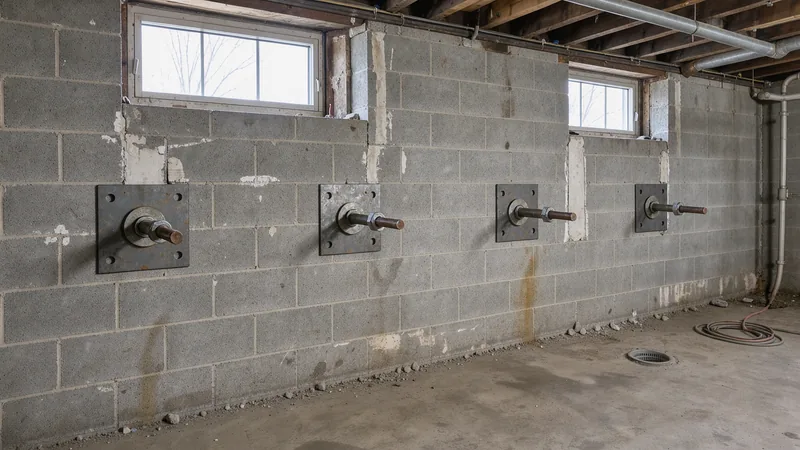
Akron Basement Pros provides wall anchors in Akron, OH.
Free Estimates · Interior & Exterior Waterproofing · Sump Pumps & Battery Backups
Steel plates buried in the yard and tied through the basement wall with rods, tightened to hold, and over time pull back, a bowed wall.
Acculevel prices wall anchors at about $830 to $1,000 each including materials and labor, with one anchor about every 5 feet; its example of a 24-foot wall needing 4 anchors comes to $3,320 to $4,000 (2020). The buried plate has to sit at least 10 feet out from the foundation, so anchors need open yard on that side of the house. Acculevel recommends them for walls bowing more than 2 inches.
Yard Space and Obstacles
Each anchor needs a clear path at least 10 feet out from the wall for the rod and the buried plate. Driveways, patios, decks, a neighbor's property line or buried utilities can rule anchors out on one side of the house; in that case carbon fiber straps, steel braces or helical tiebacks, usually 14 to 21 feet long according to Acculevel, are the alternatives.
Tightening Over Time
Anchors are tightened at installation and can be tightened again in later years, which may slowly pull a wall back toward straight as the soil allows. Ask the provider whether follow-up adjustments are included in the warranty, how often they are done and whether there is a charge.
Frequently Asked Questions
How much does basement waterproofing cost in Akron?
Fixr puts the national average at about $5,000, with most jobs between $3,000 and $10,000 (February 2026). This Old House lists interior methods at about $3,000 and exterior methods at $7,000 or more. These are national figures; a local provider prices your basement after an inspection.
How much does basement waterproofing cost per square foot?
Fixr puts it at roughly $3 to $10 per square foot of basement. Interior drain tile is priced by the linear foot instead: $40 to $120 per foot according to Fixr, $60 to $120 according to This Old House. Coatings run $1 to $8 per square foot of wall.
Is basement waterproofing worth it?
It is worth it when it fixes the cause of the water. Check gutters, downspouts and grading first, since they are the cheapest fixes. Ask each provider to explain in writing where the water enters and how the method stops it, and compare two or three quotes before signing.
Is interior or exterior waterproofing better?
Exterior work keeps water out of the wall but needs excavation and costs more ($7,000 to $15,000, This Old House). Interior drain tile manages water after it reaches the wall and avoids digging up driveways and landscaping. The right choice depends on where water enters and what is around the house.
Why does my basement flood when it rains?
Common causes are downspouts that empty next to the wall, soil sloping toward the house, cracks in the wall, water at the wall-floor joint, a failed sump pump and window wells without a drain. Water rising from the floor drain is usually a sewer backup, which is a different problem.
Why does my basement smell like sewer?
Akron's sewer brochure says odors are often caused by dry P-traps or missing or broken cleanout caps in the house. Pour water into unused floor drains and check the cleanout caps. If the smell continues, Akron residents can call the Utilities Dispatcher at (330) 375-2666 to check the main.
Does homeowners insurance cover a flooded basement?
It depends on the policy and the cause. Akron's sewer brochure notes that sewer backup coverage may need an addition to a homeowner's policy. FEMA says flood insurance covers only certain items in a basement, such as furnaces, water heaters and sump pumps, not finished walls or flooring. Ask your agent.
How much does a sump pump cost to install or replace?
Fixr puts a new pump and pit at a national average of $1,400, mostly $800 to $2,000, and replacing a pump in an existing pit at $350 to $1,000. A battery backup unit runs $150 to $2,000.
How often should a sump pump be replaced?
There is no fixed date; it depends on how often the pump runs and its build. Test it each spring by filling the pit with water. Replace it if it hums without pumping, cycles rapidly, runs with an empty pit or shows rust and noise.
What causes bowing basement walls, and what does the repair cost?
Wet soil pressing on the outside of the wall pushes it inward. This Old House puts 12 carbon fiber or steel reinforcement strips at $4,000 to $12,000, and Acculevel prices wall anchors at about $830 to $1,000 each (2020). Better drainage outside reduces the pressure.
Wall anchors or carbon fiber straps?
Acculevel recommends carbon fiber straps for walls bowing 2 inches or less and wall anchors for larger bows. Straps go on the inside, about every 4 feet; anchors need open yard at least 10 feet out from the wall. Steel I-beam braces are another inside option.
Do I need a permit for basement waterproofing or foundation repair?
It depends on your city and the work. Structural repairs, wall rebuilds, egress windows and some plumbing work are the most likely to need one. Ask the provider who files the permit and confirm with your city's building department before work starts.
Is crawl space encapsulation worth it?
It helps when a crawl space is damp or musty, as long as any standing water is drained first. This Old House puts encapsulation at about $5,500 on average, from $1,500 to $15,000. A dehumidifier keeps humidity below 60 percent, as EPA recommends.
Who does the work when I call this site?
This site does not do the work. It passes your request to a local basement waterproofing or foundation repair provider in the Akron area, who contacts you. Ask that provider for proof of licensing and insurance, a written quote and the warranty in writing.
Which towns does this site cover?
Akron, Cuyahoga Falls, Stow, Barberton, Green, Hudson, Tallmadge, New Franklin, Norton and Fairlawn in Summit County; Kent in Portage County; Wadsworth in Medina County; and the smaller communities of Munroe Falls, Mogadore, Silver Lake, Portage Lakes and Montrose-Ghent.